ChatGPT Is the Fastest App to Hit $5 Billion on Mobile

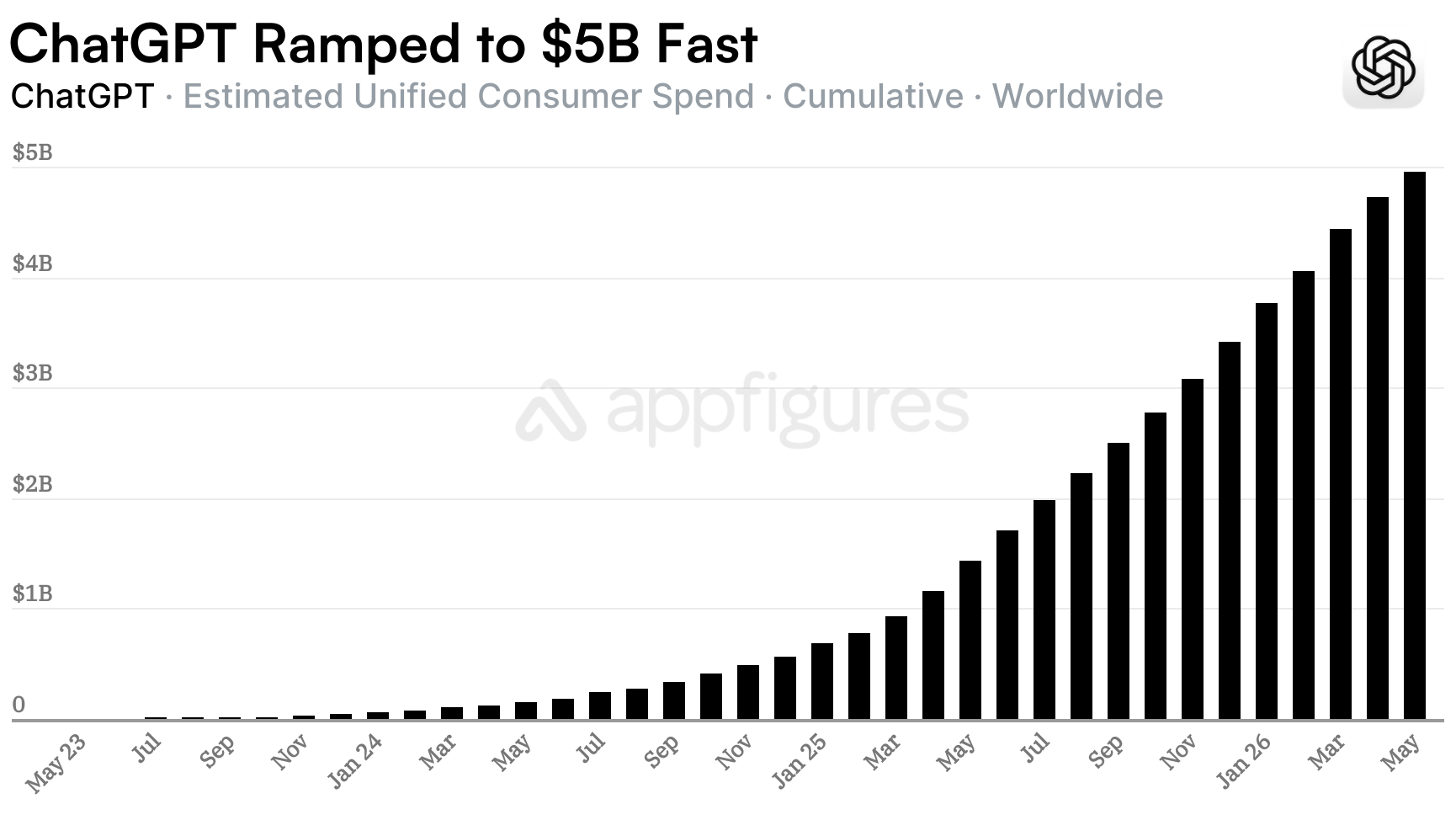
ChatGPT just crossed an estimated $5B in mobile consumer spending, and it got there in a way no other non-game app has.
The app launched on the App Store in May of 2023 and on Google Play in July. Roughly three years later, according to Appfigures Intelligence, it has generated an estimated $5B from mobile users.
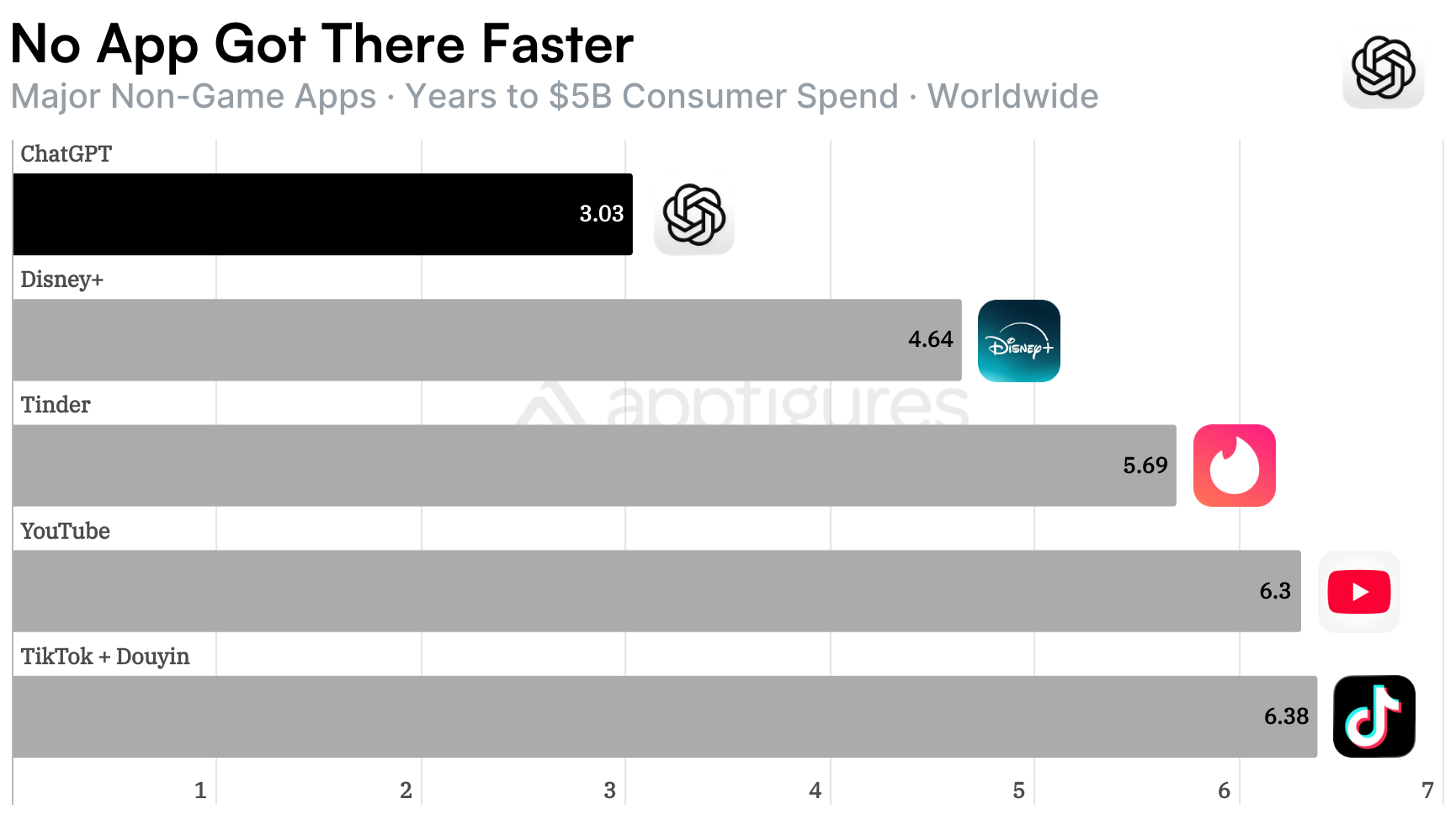
Very few non-game apps ever get to $5B on mobile. Since 2017, only four others have reached that level worldwide, according to our estimates: YouTube, Tinder, Disney+, and the TikTok family, which includes TikTok, TikTok Lite, Douyin, and Douyin Lite (TikTok's China versions).
ChatGPT got there faster than all of them.
Disney+ was the closest of the group, reaching $5B in 4.6 years. Tinder needed 5.7 years from the beginning of 2017. YouTube and the extended TikTok family needed more than 6.
ChatGPT did it in roughly three.
The speed is only half of the story. ChatGPT's mobile app has generated $5.01B in consumer spending from 1.2B estimated downloads worldwide. That's $4.14 for every download since launch.
That combination is what makes the milestone so unusual. ChatGPT is a subscription app, but it reached a mass-market consumer-app audience before its revenue curve caught up. Once it did, the curve moved fast.
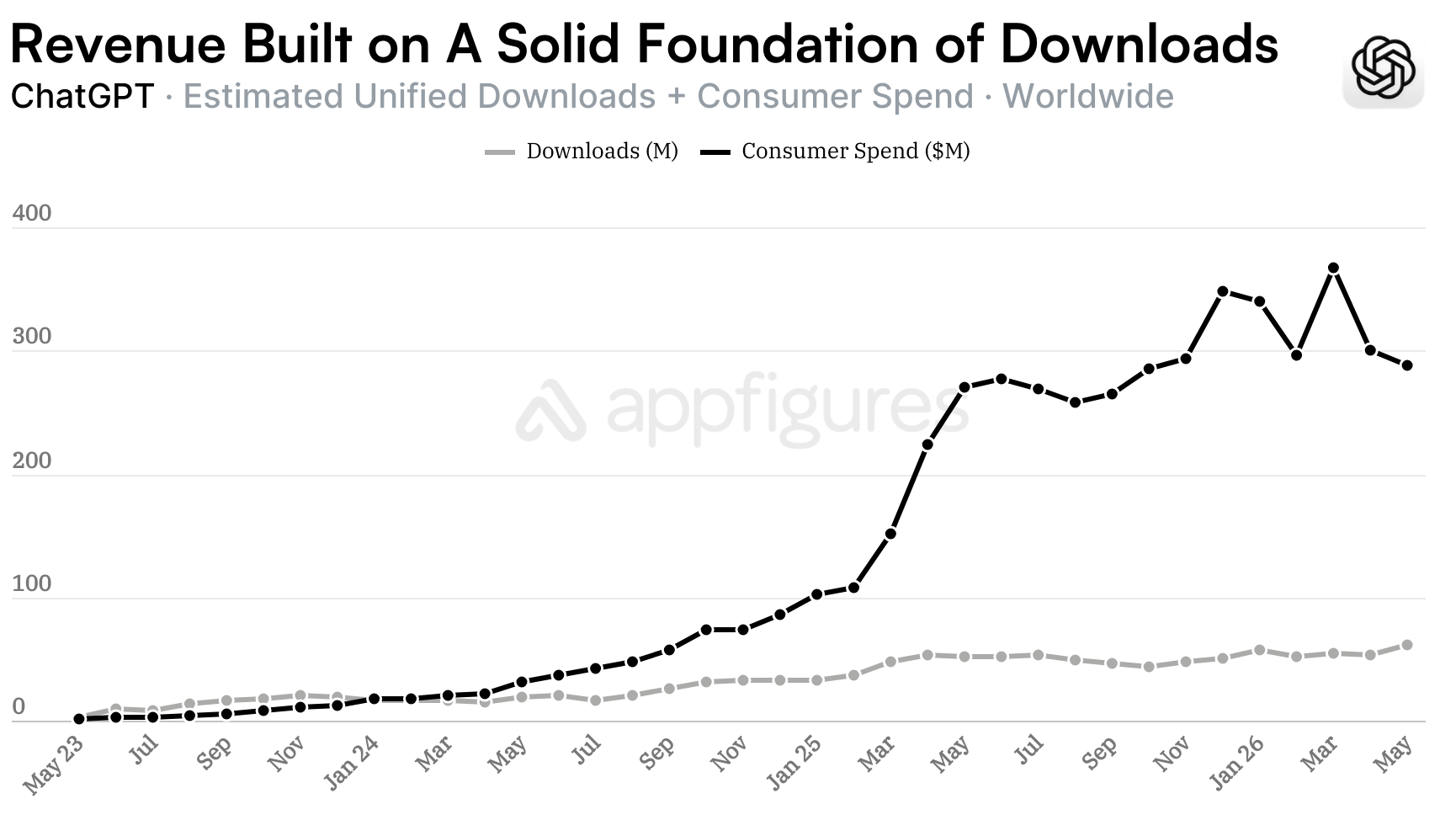
In 2023, ChatGPT was already one of the biggest app launches in recent memory, but the mobile business was still early. The app got 107M downloads from May through December and generated about $47M in mobile consumer spending.
In 2024, downloads more than tripled to 262M while consumer spending rose to $527M. Then 2025 changed the scale completely. ChatGPT got 565M downloads and generated $2.8B in spending.
That is why the $5B milestone arrived so quickly. Downloads kept expanding, but revenue grew much (much) faster.
The shift shows up clearly in revenue per download. ChatGPT started with less than $1 in consumer spending per download for most of 2023. By the end of 2024, it was above $2.50. In 2025, it moved into a different range entirely.
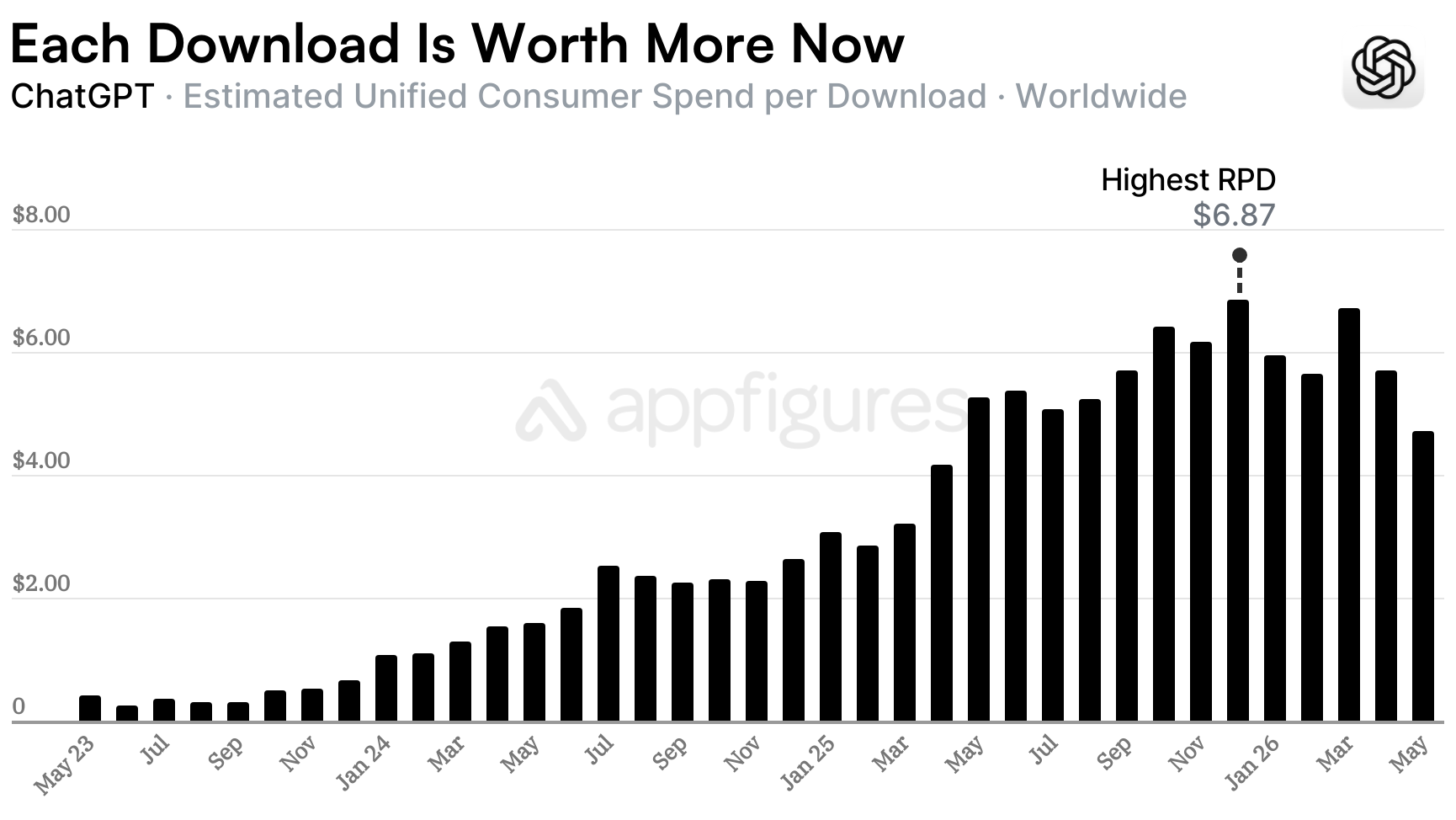
December 2025 was the strongest month in the dataset by revenue per download, at $6.87. March of 2026 was close behind at $6.73. October, November, January, February, and April were all above $5.60.
That puts ChatGPT's lifetime consumer spend per download ahead of the expanded TikTok family, which is at $3.69 across the portfolio. It's still below older subscription-heavy apps like YouTube, Tinder, and Disney+, but those apps took much longer to reach $5B.
That's the shape of ChatGPT's mobile business: social-app scale with subscription-app monetization, reached in roughly three years.
The rest of the AI category makes that lead look even bigger.
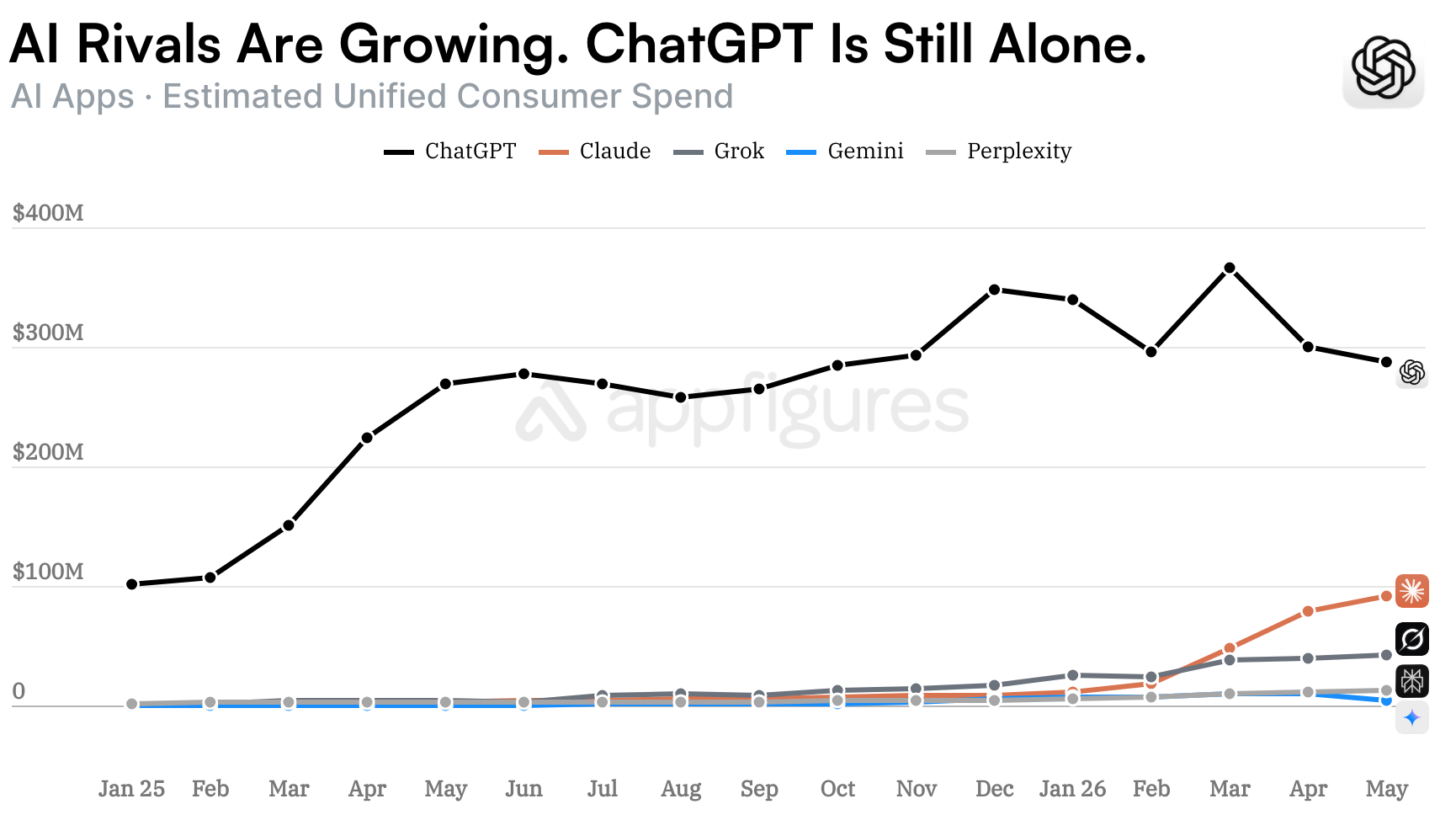
Claude and Grok are already real mobile businesses. Claude has generated $319M in mobile consumer spending, according to our estimates, and May is its biggest month yet at $92M. Grok has generated $264M and made $43M in May. Perplexity is above $100M in lifetime mobile consumer spending and made $14M in May.
For most apps, those would be standout results. In AI, they show how far the category still is from ChatGPT's scale. The strongest ChatGPT months are not just ahead of other AI apps' monthly revenue, they're in the range of what most rivals have made on mobile in total.
OpenAI took the fastest-growing consumer software product in recent memory, put it on mobile, and turned it into a $5B app-store business before any other AI app crossed even $500M.
That's what competitors are chasing now. Not just more attention or a better model, but the ability to turn a huge mobile audience into recurring app-store spending at ChatGPT's scale.
App Intelligence for Everyone!
The insights in this report come right out of our App Intelligence platform, which offers access to download and revenue estimates, installed SDKs, and more! Learn more about the tools or schedule a demo with our team to get started.
Are you a Journalist? You can get access to our app and market intelligence for free through the Appfigures for Journalists program. Contact us for more details.
All figures included in this report are estimated. Unless specified otherwise, estimated revenue is always net, meaning it's the amount the developer earned after Apple and Google took their fee.