ChatGPT Crosses $3 Billion in Mobile Revenue, Cementing AI's Paid Future

When OpenAI launched ChatGPT's iOS app in May 2023, the question wasn't whether people would use it but whether they'd pay for it. Thirty-two months later, we have our answer: ChatGPT just crossed $3 billion in consumer spending through its mobile apps alone, according to estimates from Appfigures Intelligence.
That's not just a milestone. It's a signal that AI has successfully made the leap from free experiment to paid necessity for millions of users.
The Slow Build, Then the Explosion
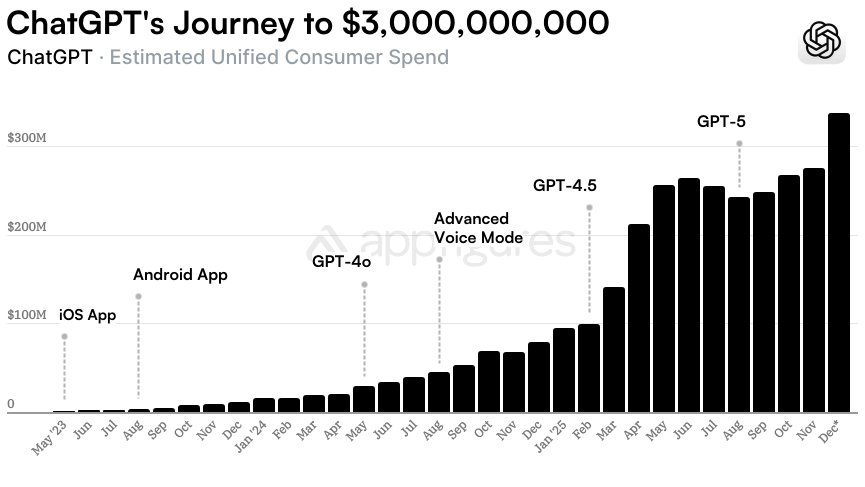
ChatGPT's mobile apps didn't start from zero. When the iOS app launched in May 2023, six months after the web version took the internet by storm, it brought in over $1 million in its first month. That's a strong start by any measure, but it was only the beginning. By the time the Android app followed in July, monthly revenue had climbed to nearly $4 million. For perspective, ChatGPT now earns that amount every eight hours.
Revenue was rising quickly and by the time OpenAI released GPT-4o May 2024, consumer spend already grew to $29 million according to our estimates, a 40% increase from the previous month. By the time Advanced Voice Mode came out in July, estimated revenue climbed to $45 million.
But the real acceleration started in early 2025. When OpenAI launched GPT-4.5 in February, estimated monthly revenue hit $99 million. By April, that figure more than doubled to $212 million per month. December 2025 closed at an estimated $338 million, more than the app earned in its entire first year.
Climbing the All-Time Leaderboard
With $3 billion in cumulative revenue, ChatGPT now ranks #24 on Appfigures' all-time revenue leaderboard across both the App Store and Google Play, a remarkable feat considering most apps in that top tier have been monetizing for years longer.
Let's put that in perspective: knowing December's revenue and with ChatGPT's subscriptions ($20/month for Plus and $200/month for Pro) we can estimate the app has roughly 10-12 million paying mobile subscribers. This isn't an accurate proxy, but even conservatively, that's millions of people who've decided AI assistance is worth a monthly subscription.
The platform split is revealing. On iOS alone, ChatGPT ranks #21 all-time, while on Google Play it sits at #52. That's a pattern we've seen before with productivity and professional tools: iOS users convert to paid subscriptions at significantly higher rates.
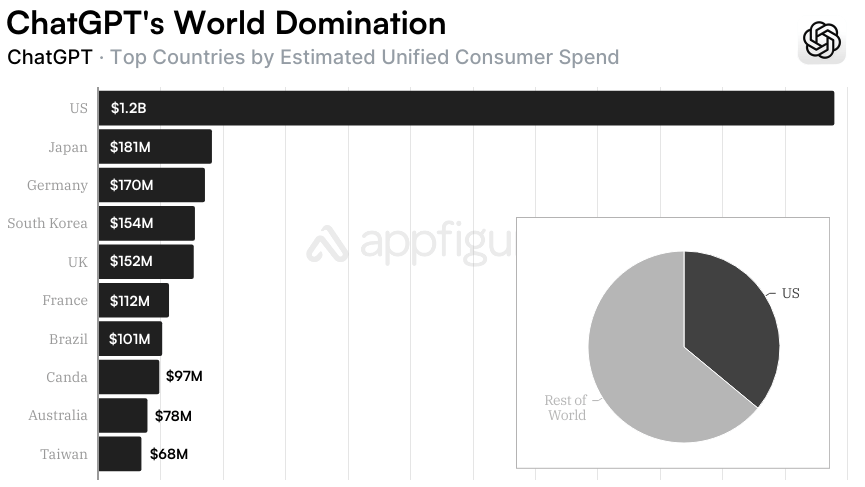
Geography tells a similar story. Based on our estimates, the US accounts for $1.2 billion of ChatGPT's revenue, more than a third of the global total. Japan comes in second at $181 million, followed by Germany ($170M), South Korea ($154M), and the UK ($152M). These aren't just wealthy markets, they're countries where professionals have integrated AI into their daily workflows.
Competition Arrived, Revenue Kept Growing
It's worth noting what didn't slow ChatGPT down: competition. DeepSeek launched in January 2025, followed by Grok's mobile app in February. Both came with plenty of hype and backing from well-known players.
Yet ChatGPT's revenue didn't plateau—it accelerated. From January to December 2025, monthly revenue tripled. Even after Google enhanced Gemini with Nano Banana, a powerful image generation add-on, in August, ChatGPT maintained its momentum.
The takeaway isn't that competition doesn't matter. It's that in AI, being first and staying ahead matters more. OpenAI set the standard, built the habit, and kept iterating faster than challengers could catch up.
What This Means
ChatGPT's $3 billion milestone isn't just an OpenAI success story, it's a validation of the subscription model for AI tools. Users aren't just experimenting with AI anymore. They're budgeting for it, the same way they do for streaming services or cloud storage.
For app developers and publishers watching from the sidelines, the message is clear: AI isn't a feature to bolt on. It's becoming infrastructure. And users are willing to pay for tools that genuinely enhance how they work, learn, and create.
How Long Can This Last?
But there's a familiar pattern emerging here, one we've seen play out with Uber, DoorDash, and streaming services: heavily subsidized pricing to build the market, followed by inevitable price increases once users are hooked.
OpenAI is burning cash to train these models. The compute costs alone for GPT-5 are astronomical, and at $20/month, ChatGPT Plus likely isn't covering the full cost per user. The $200/month Pro tier is closer to realistic pricing, but even that might be subsidized to build the premium segment. Right now, OpenAI can afford this because they're in growth mode, armed with nearly $60 billion in funding raised, and focused on market dominance.
But what happens when the subsidy ends? We've seen this movie before. Uber rides got more expensive once drivers and riders were locked in. Netflix went from $7.99 to $15.99. Food delivery added fees until the convenience barely justified the cost. The playbook is always the same: attract users with below-market pricing, become essential, then raise prices to sustainable levels.
When ChatGPT's prices inevitably climb, will users keep paying? At $30, $40, or $50 per month for Plus, or $300+ for Pro, the calculus changes. Some will churn. Others will finally ask whether they really need AI assistance, or if they just got used to having it.
The $3 billion milestone proves people will pay for AI. The real question is how much they'll pay once the training wheels come off and the true cost of intelligence becomes clear.
App Intelligence for Everyone!
The insights in this report come right out of our App Intelligence platform, which offers access to download and revenue estimates, installed SDKs, and more! Learn more about the tools or schedule a demo with our team to get started.
Are you a Journalist? You can get access to our app and market intelligence for free through the Appfigures for Journalists program. Contact us for more details.
All figures included in this report are estimated. Unless specified otherwise, estimated revenue is always net, meaning it's the amount the developer earned after Apple and Google took their fee.