This Week in Apps - Tricked to the Top

This Week in Apps is a short, no-fluff, round-up of interesting things that happened in the mobile industry. Here are our top highlights.
U.S. Revenue Index (vs. 30 days ago)
Insights
1. The App That Tricked TikTok To The Top of the App Store
There's an app sitting at the top of the US App Store right now, right alongside ChatGPT and Google Gemini, and there's a good chance you've never heard of it. It's called Freecash, a rewards app where users earn money by playing games, completing surveys, and testing apps. It's been parked in the top 5 for almost two months.
How did a rewards app get there? TikTok ads that promised "$35 an hour to scroll your For You page." The ads were styled to look like organic TikTok content, featuring a woman who appeared to be earning money just by scrolling. They went viral, but the woman wasn't a TikTok employee and the campaign had nothing to do with TikTok. The ads eventually got flagged and removed, but by then the downloads were already done.
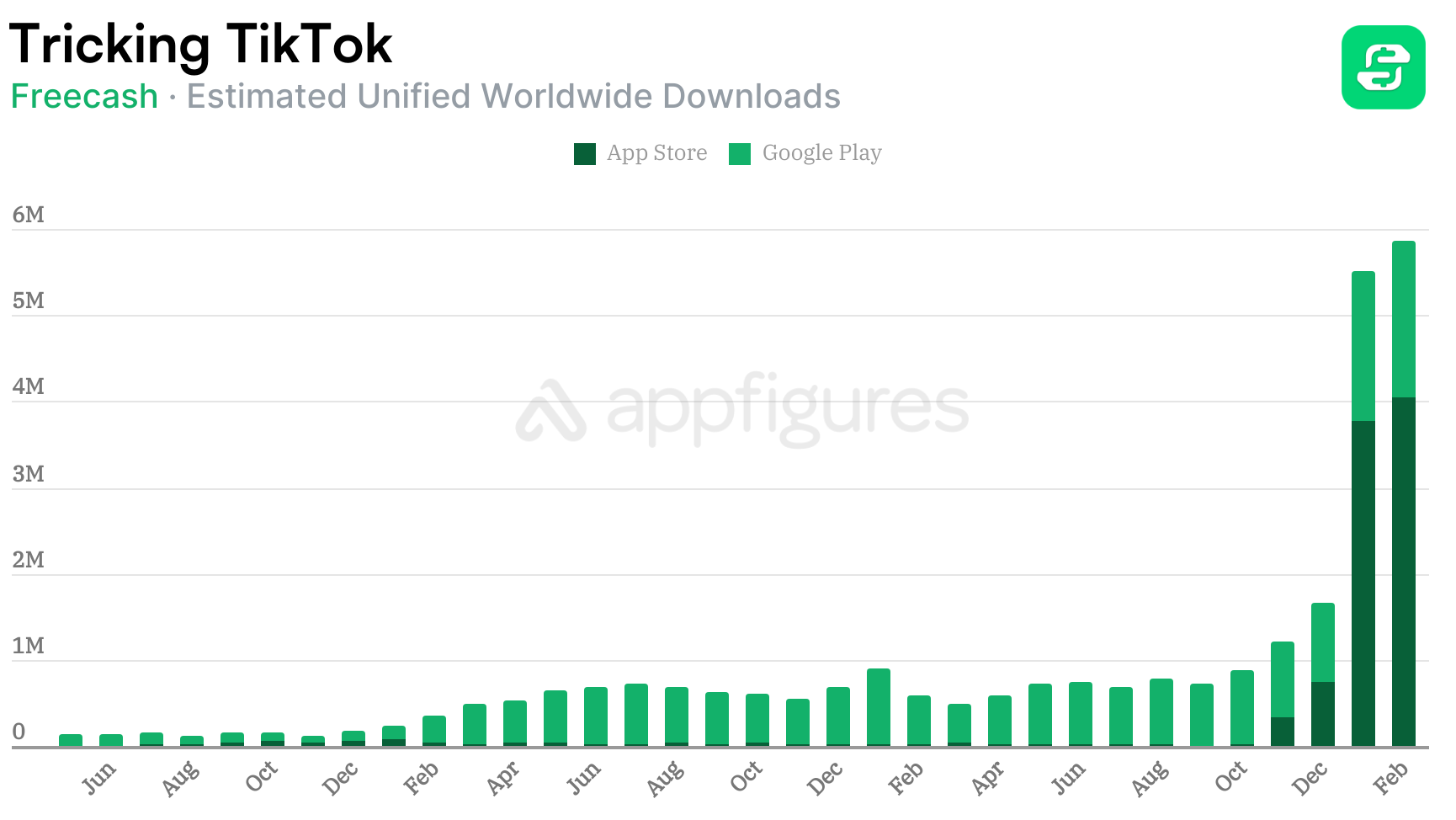
According to Appfigures Intelligence, Freecash went from 876K combined downloads in October to 5.5M in January and almost 6M in February. That catapulted it to #2 in the US App Store, where it's held a top-5 spot nearly every day since January 8th - over 50 days and counting. All-time downloads have now crossed 31M across both stores.
But here's the part that makes this story different from a typical viral moment. Freecash is owned by Almedia, a company its CEO describes as a data platform. The rewards users earn are the acquisition cost. The real business is collecting spending data to identify gamers who could become big spenders and targeting them with ads for popular games. That means the economics could be self-sustaining, which explains why the growth hasn't faded.
The full story breaks down how Freecash climbed to #2 in the US App Store and has held a top-5 spot for over 50 days - and what's keeping it there.
2. King Brought Candy Crush to Solitaire, but Disney Took the Crown
King launched Candy Crush Solitaire in February 2025 with one of the most recognizable brands in gaming behind it. It was the first new Candy Crush title since the Microsoft acquisition, and expectations were high. A year later, the game brings in roughly $1M a month in estimated net revenue. For most indie studios that's great, but for a Candy Crush game backed by King and Microsoft, the brand simply didn't translate.
Two months after Candy Crush Solitaire launched, Disney Solitaire showed up and changed everything. Built by SuperPlay, a studio Playtika acquired for $700M, it took a completely different trajectory. According to Appfigures Intelligence, Disney Solitaire earned an estimated $137M in net revenue in its first 11 months. Candy Crush Solitaire earned $12M over the same period. That's more than 10-to-1.
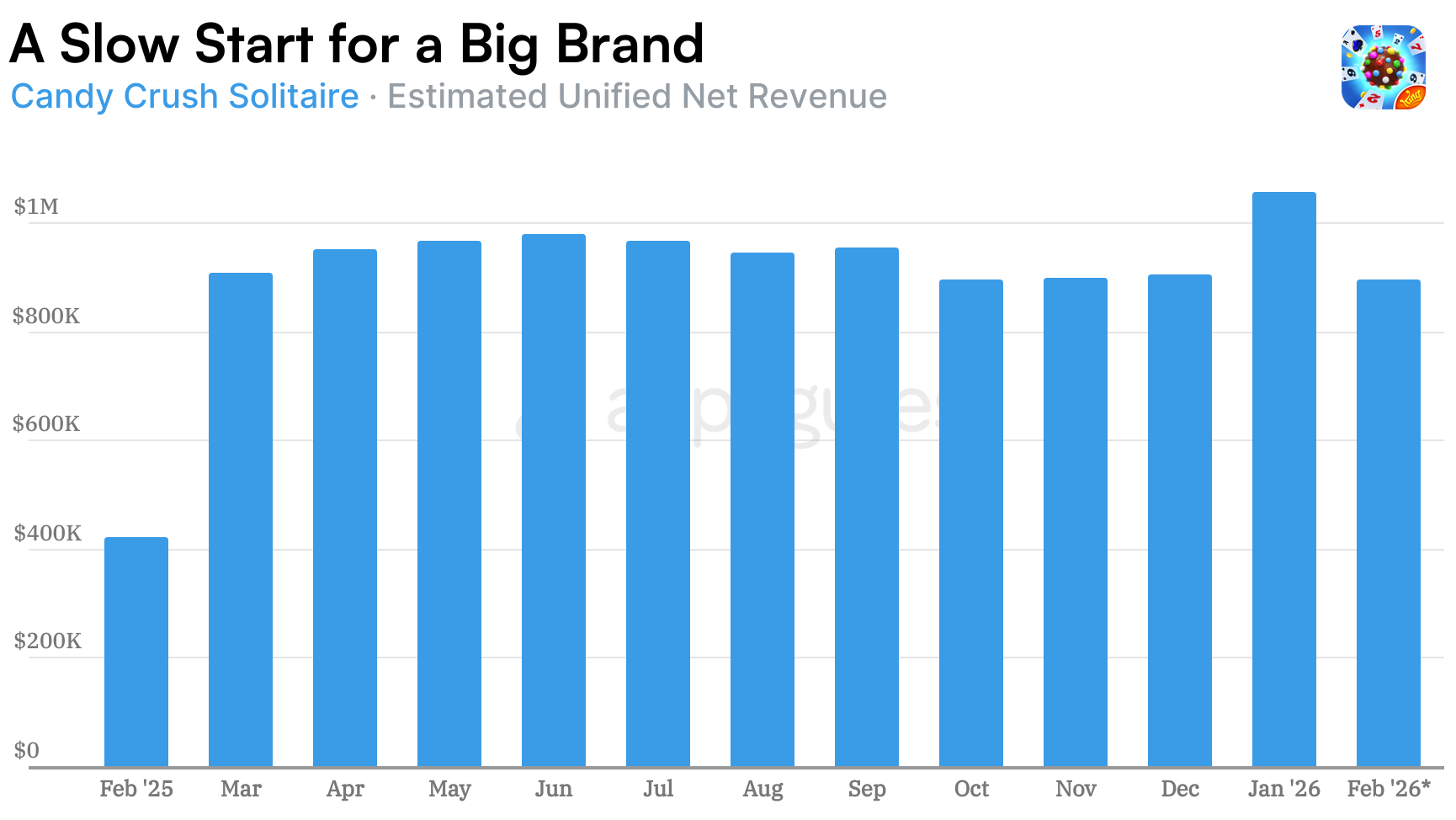
The gap is getting wider, not smaller. Our estimates put Disney Solitaire at $21M in net revenue for February, earning nearly 2x more than the rest of the top five solitaire games combined. Candy Crush Solitaire dipped below $900K for the first time since launch. Same category, same TriPeaks mechanic, very different IPs, and the results show that an emotional connection to characters beats a candy-themed puzzle brand every time.
What makes this even more interesting is the Playtika angle. They already had Solitaire Grand Harvest pulling in $14M a month, and Disney Solitaire is cannibalizing it. But combined, their solitaire portfolio earned $27M in February, nearly double what Grand Harvest was earning alone a year ago. Cannibalizing yourself is fine when the new thing grows faster than the old thing shrinks.
The full analysis has the complete solitaire revenue scoreboard, and the gap between Disney and everyone else is even wider than you'd think.
See Appfigures In Action
Better intelligence to beat the competition faster!
3. Peacock Is About to Cross 100 Million Downloads
The 2026 Winter Olympics kicked off in February, and Peacock's downloads exploded. According to Appfigures Intelligence, daily downloads jumped from around 44K to nearly 200K on opening weekend - a 5x spike overnight. Through the first three weeks of February alone, Peacock pulled in 1.9M downloads, more than double all of February 2025.
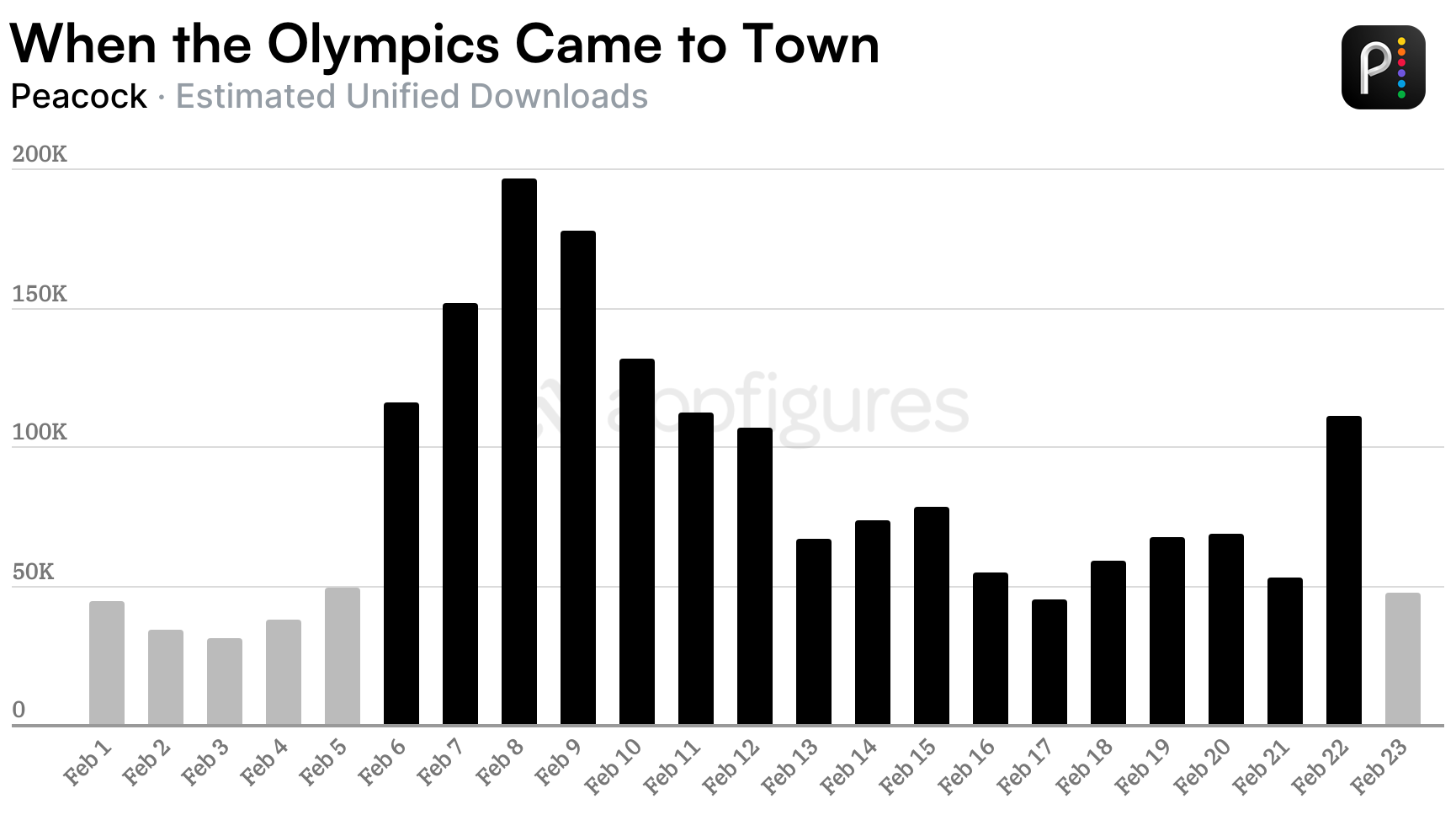
This isn't Peacock's first Olympics rodeo either. The 2024 Summer Olympics in Paris drove 2.9M downloads in July. NBC knows exactly what it's doing here - sports drive downloads, and they've built the playbook for it.
But the real story is revenue, not downloads. Our estimates show Peacock's net revenue nearly doubled in two years, going from $34M in January 2024 to $63M in January 2026. For all of 2025, we estimate Peacock generated $674M in net revenue, up 44% from $466M the year before. Meanwhile, Disney+ has stalled at roughly $1.4B and Hulu's revenue dropped 22% year over year.
With 100M all-time downloads just days away and revenue on pace to hit $800M in 2026, Peacock has gone from streaming underdog to a real force. The full piece breaks down the Disney comparison, the Olympics effect in detail, and what's next for NBC's streamer.
4. Claude's Super Bowl Bet Paid Off
Anthropic ran its first-ever Super Bowl ad, a darkly comedic spot mocking ChatGPT for stuffing ads into AI responses. The message was simple: Claude doesn't do that. And the numbers say people loved it.
Claude went from a daily average of 62K estimated downloads to 225K, a 3.6x spike triggered by a single ad. But here's what's interesting - the peak didn't come on game day. It came over a week later, on February 17th, according to our estimates. That's word of mouth and press coverage doing exactly what a Super Bowl ad is supposed to do: keep the conversation going.
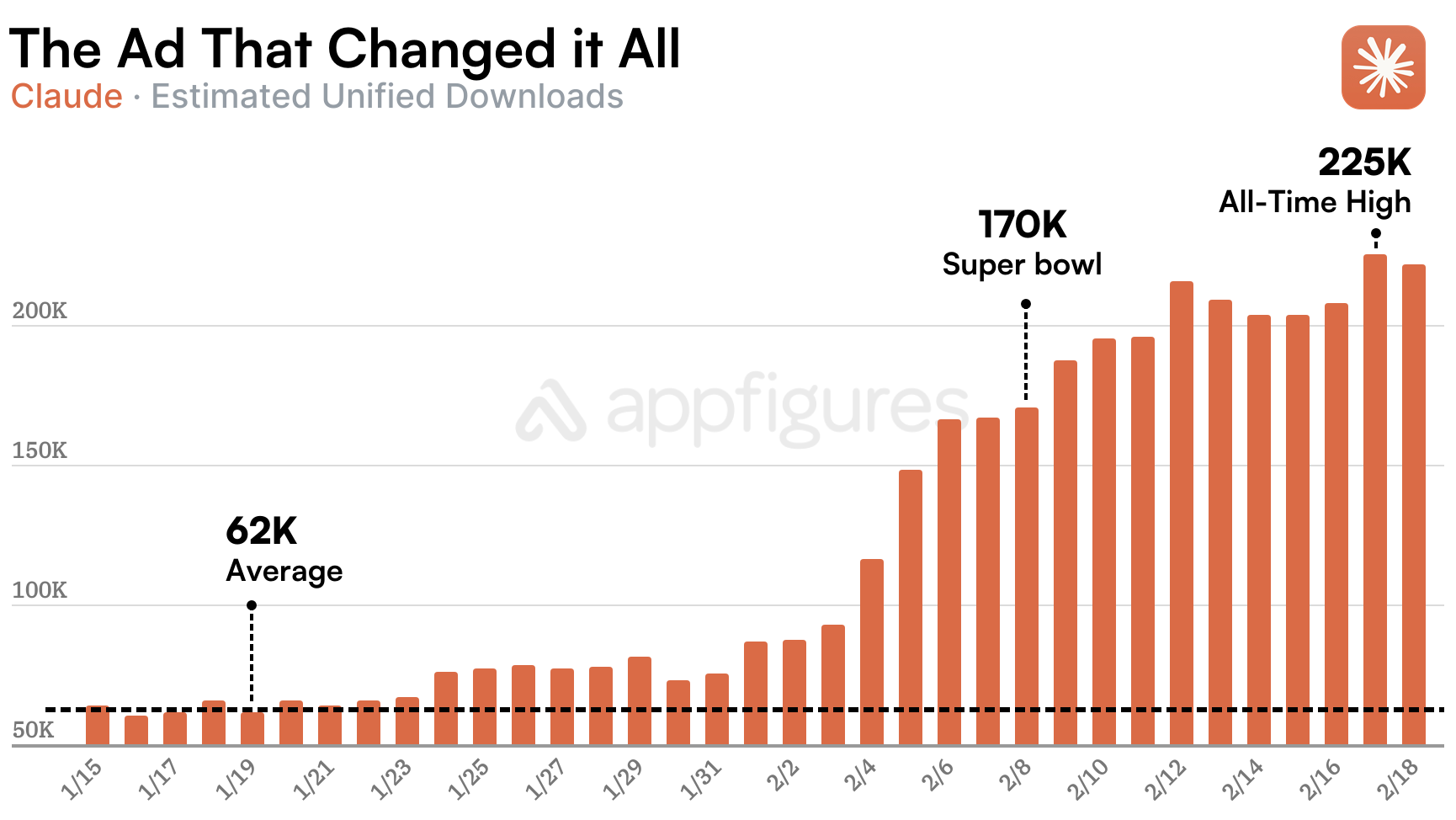
Revenue told the same story. Daily net revenue went from an estimated $270K to $545K at peak, a clean 2x. February is pacing for roughly 5M downloads and $11M in net revenue, according to Appfigures Intelligence. That's a 4x jump in monthly downloads compared to six months ago.
Let's not get carried away though. ChatGPT pulled in 56M downloads and $224M in net revenue in January alone. Claude is still tiny. But during Super Bowl week, Claude's downloads rose 211% while every other AI app went the other direction - ChatGPT dipped 2%, DeepSeek was flat, Gemini dropped 12%. The Super Bowl effect was entirely Claude's, and the "we don't put ads in your AI" positioning clearly resonated.
The full analysis covers how Claude stacks up on revenue per download, why the spike hasn't faded yet, and what this means for the AI app race in 2026.
Ready to Beat the Competition?
Appfigures has the intelligence you need
5. Hallow's Most Predictable Spike Is Also Its Most Impressive
Every year, like clockwork, Hallow goes from a steady prayer app to one of the most downloaded apps in the App Store. Ash Wednesday landed on February 18th this year, and on that single day Hallow was downloaded 263K times, according to Appfigures Intelligence. That's roughly 25x its normal daily average.
The engine behind it is Hallow's Pray40 challenge, a 40-day guided program featuring Mark Wahlberg, Chris Pratt, and Gwen Stefani that kicks off every Lent. It's a brilliant growth loop - celebrity names drive curiosity, Ash Wednesday creates urgency, and the 40-day commitment locks users into the app through Easter. In just the first 22 days of February, Hallow racked up 1.2M downloads. For context, it averaged about 280K per month through most of 2025.
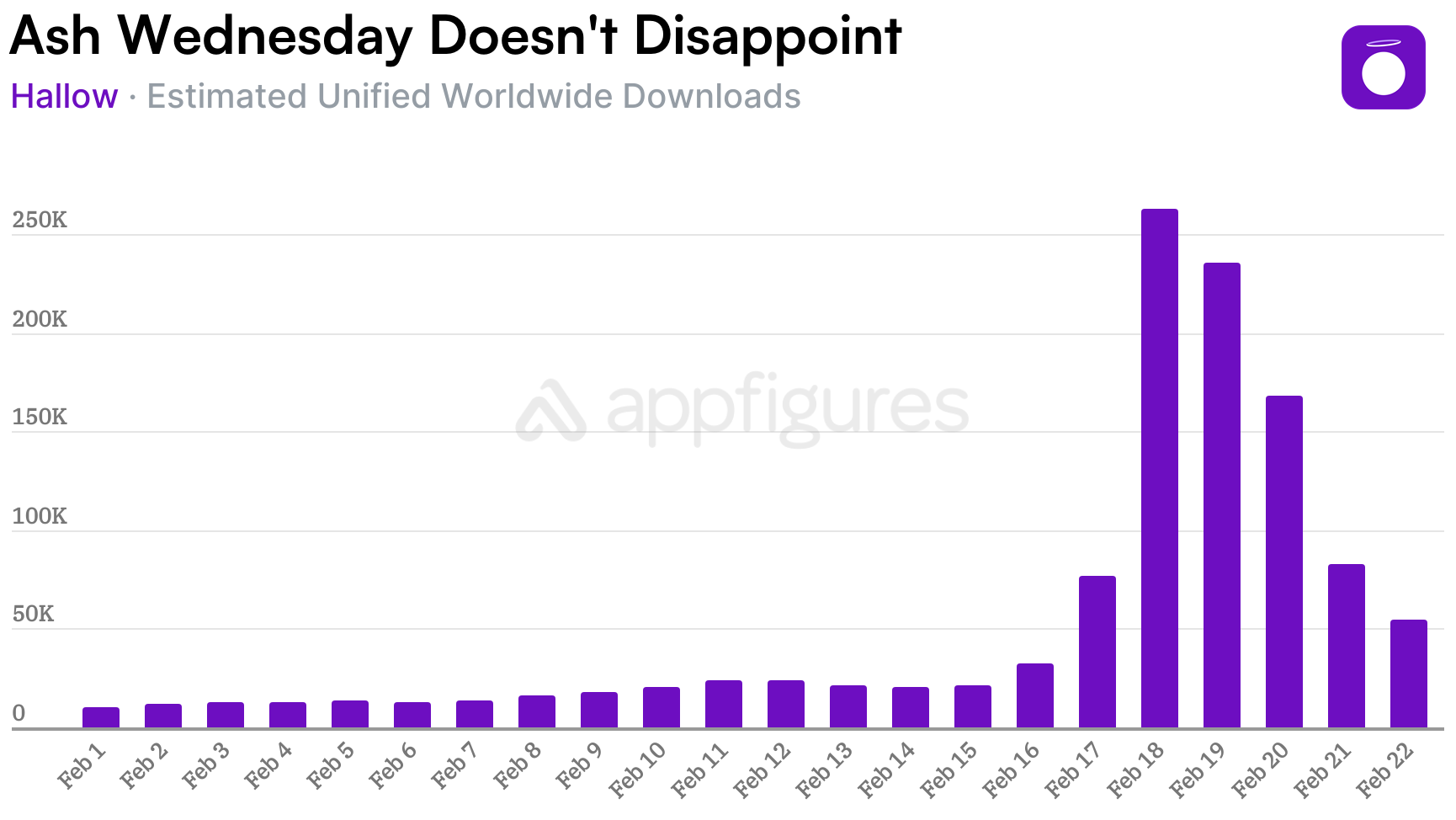
But here's where it gets interesting. The Ash Wednesday spike itself is remarkably consistent - 263K in 2024, 226K in 2025, 263K again this year. Almost like the calendar sets a ceiling on day-one demand. The weeks around it, though, tell a different story. The Lent surge peaked at 2M downloads in 2024, dropped to 1.5M in 2025, and this February is tracking at 1.2M and it's not slowing down. The spike is clockwork, but the surrounding growth is fading.
The revenue story adds another layer. Hallow offers free trials, so most of those Ash Wednesday downloads won't convert until March or April. That's exactly what prior years show - March 2024 hit $10M in net revenue, April 2025 hit $9.7M. Our estimates put Hallow at roughly $40M in net revenue for 2025, which for a prayer app with essentially no competition at that level, is remarkable. The full analysis digs into whether Hallow is hitting its natural ceiling and what the revenue conversion looks like this year.
App Intelligence for Everyone!
The insights in this report come right out of our App Intelligence platform, which offers access to download and revenue estimates, installed SDKs, and more! Learn more about the tools or schedule a demo with our team to get started.
Are you a Journalist? You can get access to our app and market intelligence for free through the Appfigures for Journalists program. Contact us for more details.
All figures included in this report are estimated. Unless specified otherwise, estimated revenue is always net, meaning it's the amount the developer earned after Apple and Google took their fee.