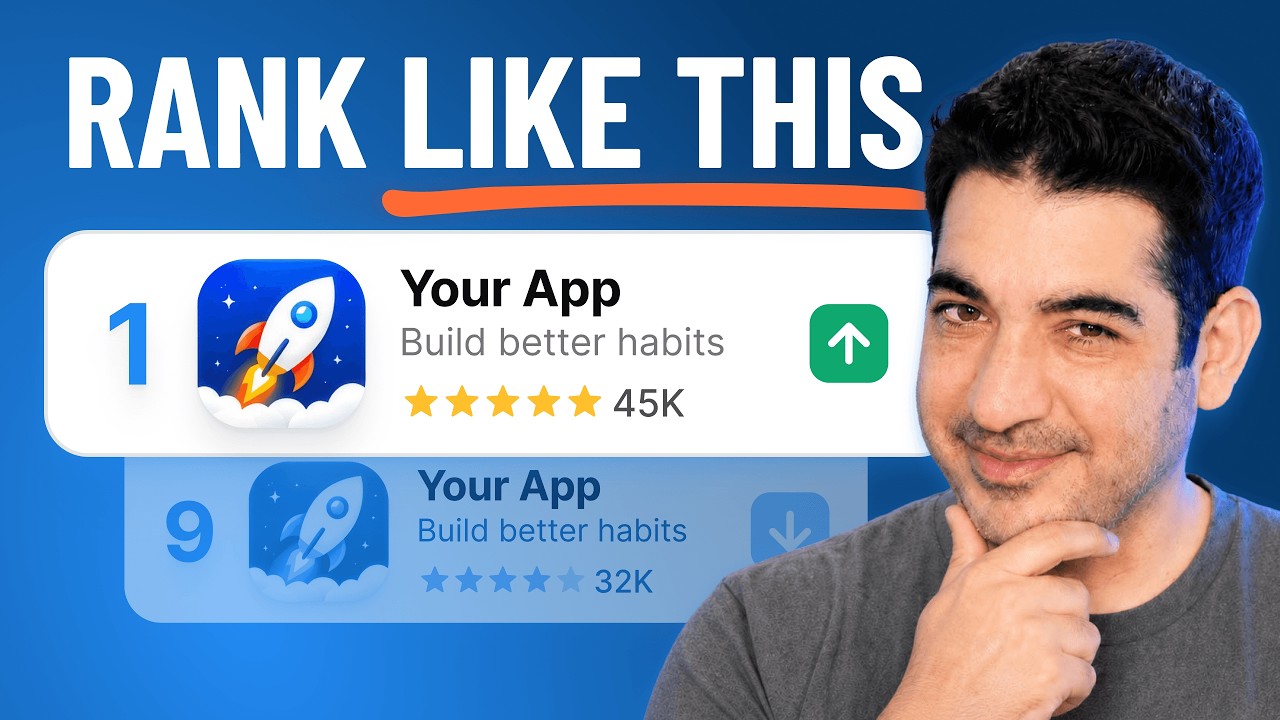
Optimizing Your Apps: Live ASO Teardown

Welcome and Live App Picker
Ariel from Appfigures welcomed everyone to a brand new live stream focused on keywords and app store optimization, which is becoming more important than ever before.
More than 130 apps were submitted for the live app teardown. Ariel said there was a treat: the entire process of selecting apps had been completely revamped. Up until now, Ariel would pick apps at random before the stream, open them in tabs, and go through them one by one. No more. This time, Ariel built something new: a live app picker so apps could be selected live.
Ariel explained that anyone who checked in to the live stream would get three times the chance of having their app picked. Their app would go into the picking tool three times instead of one. Ariel said that is what viewers get for being live and chatting. The check-in link was shared in chat.
Ariel introduced the live app picker and explained that the screen showed all submitted apps. Apps from people who checked in showed a 3X badge and appeared in the picker three times. Ariel said the selection was completely random.
For each app, Ariel planned to look at the names and subtitles to see if the keywords were helping downloads or hurting downloads. Ariel also planned to look at screenshots, because screenshots are really important to downloads these days.
Archive Shadow Work
The first selected app was Archive Shadow Work.
Ariel read the listing: “Archive Shadow Work. Journey of Self-Discovery.” Ariel asked whether it was a game, then read: “Daily psychological stories, guided self-reflection, and dream interpretation rooted in Jungian psychology.”
Ariel said the first challenge was that when an app does not have an audience waking up in the morning saying, “This is what I want, let me go into the App Store and get it,” the app has to make it really simple for people to understand what is going on.
Ariel did not see that simplicity in the listing and said that was a great opportunity.
Ariel tested “self-discovery” and found that it had a popularity score of five, which was lower than expected.
Ariel said it was hard because the keywords in the listing did not feel like keywords someone would go into the App Store and search for. If the app is for self-discovery, the team has to figure out what keywords people use when they are looking for self-discovery.
Ariel looked at other apps, starting with Breeze, because it appeared to be doing something right and making money. Ariel looked at what Breeze was doing organically and reviewed its number one keywords. A lot of them were fives, which was interesting. Ariel filtered for anything above a nine or ten in popularity.
The visible keywords included Breeze, trauma test, Ahead app, mental health test, self app, self-care, BetterHelp, Calm Harm, personality tests, Reflectly, and therapist. Ariel said these were all over the place. There was nothing clearly exciting or specifically self-help except maybe self app or self-care. BetterHelp was a competitor. Reflectly was probably another competitor. Calm Harm was probably a play on calm.
Ariel said this was the main challenge of the app.
When you think about App Store Optimization, you cannot just take any app and make it successful with App Store Optimization. App Store Optimization means that you appear in searches, but for searches to work for you, those searches have to exist.
Ariel said the main challenge and opportunity was that nothing in the name or description was giving a reason to find the app. Ariel initially said people were not going to search for “shadow work” or the app name, and that the only visible useful keyword seemed to be self-discovery, which had low popularity.
Ariel advised going back to first principles: what is this app giving people? What the app gives people should translate into a keyword someone is looking for. That is what should be optimized for.
If that is difficult, Ariel suggested looking for other apps doing similar things, or apps doing something like this in a slightly different field. From there, you can get to keywords that are actually useful and bring them in.
Ariel also noted that the app name did not really have any keywords and said this is common across many apps.
Then Ariel searched for “shadow work” in Keyword Inspector and revised the earlier assessment. Shadow work appeared to be a real thing and also the name of a competitor. Ariel said this was a reminder to always use Keyword Inspector first.
Shadow work had a popularity score of 25. Ariel said it was pretty popular, not very competitive, and not showing a lot of performance. Apps ranking for it had 13 new ratings, three new ratings, and similar low numbers, which meant ranking could be possible.
The app was number nine with nine ratings, while some higher-ranking apps had fewer ratings. Ariel recommended putting “Shadow Work” at the beginning of the name, not at the end, like the app “Shadow Work, Mind Work.”
Ariel explained that everything on the App Store is read from left to right. Google Play works the same way in English and other left-to-right languages. If the algorithm reads from left to right, the most important keyword should be on the left, at the beginning.
Ariel said flipping the name could lead to an immediate increase, maybe into the top five after a few days, a week, or two weeks.
Ariel also said that just because an app has a name and subtitle does not mean every character needs to be used. The subtitle can be very short. The name can be as short as possible. The current name was already short, which was good.
Ariel recommended shortening, focusing, and not using “journey” and “self-discovery” just because other apps use those terms. Self-discovery was a five and was not helping much.
Ariel repeated: focus, focus, focus. Reduce the number of keywords. Make sure there is no duplication in the keyword list.
Screenshots for Archive Shadow Work
Ariel compared the screenshots to other apps ranking for shadow work. Some competitor screenshots were similar, but Ariel did not think they were very good because it was not clear at a glance what was going on.
Ariel said the app needs keywords in screenshots, not just for the algorithm, but also for people. A year ago, nobody said screenshots were for the algorithm, and now they are really for the algorithm, but people still matter.
When you use a keyword from the name in the screenshots, you reinforce what people see. That is exactly why Apple uses it as a signal for rankings.
One screenshot included “guided shadow work journal” in the second screenshot. Ariel thought that should be in the first screenshot because that is what people see instantly.
Ariel recommended simplifying the screenshots, using keywords from the name in the screenshots, and continuing to clarify what the app does for people.
If the app can find more keywords related to shadow work, or if it wants to go after journals and stories, Ariel recommended moving journals and stories into a separate localization.
Ariel explained that the US App Store can read 10 different localizations and index them in the US. If you have English keywords in the name, subtitle, and keyword list in Vietnamese, for example, the US App Store will read those and index the app for those keywords.
Ariel said fewer keywords, more localizations, improved screenshots, and flipping the name could help the app get into the top five relatively quickly.
Stock Market King Day Trade
The next app selected was Stock Market King Day Trade.
Ariel read the listing: “Stock Market King Day Trade. Paper trading simulator and game.” Ariel said this was interesting because it was not really a trading app, but a pretend trading app.
The screenshots and text said: “Learn stock trading without the risk. Compete with friends. See your progress clearly. Real-time price updates. Ad-free and risk-free trading.” Ariel liked the concept and said it was probably a better way to learn than losing money by trading improperly.
Ariel said that when it comes to trading, there is a lot going on. Mostly, people are looking for apps to trade, not apps to simulate trading. The listing has to make sure either people are looking for this or, once they land on it, they know what is going on.
Ariel identified “Stock Market King” as the name, “Day Trade” as another set of keywords, and “Paper trading simulator and game” as what the app really is.
Ariel said the listing was not bad, but there was a lot going on. When the algorithm sees a lot, especially on the App Store, it does not like it. It likes focus.
Because the US has 10 localizations to work with, Ariel said you can separate the focuses: one focus per localization, 10 times. Ariel said there should never be a case where you cannot focus because you have too many topics in your name.
Ariel assumed “King” was the name and “stock market” was for keywords, which was clever. Ariel tested “day trade” because people may look for that, especially since laws changed around day trading and more people can do it.
For “day trade,” the results included Trade, TradingView, Robinhood, Webull, forex trading, Stocks from Apple, and trading games. Ariel noted as a side note that Apple’s apps are always number one or number five for some reason.
Ariel said it was good news that E-Trade was not high and Fidelity was very low. “Day trade” had a popularity score of five, so it would not bring a ton of downloads, but a five is becoming more valuable as the App Store grows.
Ariel explained that popularity is on a log scale. The app with the most visibility is 100. Apps with little visibility may be five. The numbers five, six, seven, and eight are buckets, and those buckets become larger as top apps continue to get more visibility.
Ariel said ChatGPT has a ton of visibility, more than Instagram. Instagram used to be the most visible app and now it is not. That pushes the value of 100 up and depresses everything else down. A 99 becomes less than what it was before, and a five becomes a larger bucket.
So fives are not terrible. They are not ideal, and if you can optimize for a five, six, 10, or 25, you should go after the 25 if you can handle it with ratings. But a five is no longer something to ignore entirely.
Ariel said “day trade” was not a super strong keyword, but not terrible. The results showed trading games, so it could work, but competing with 6,000 ratings, 17,000 or 18,000 ratings, or even 1,000 ratings for a popularity five was not worth it.
Ariel tested “stock market” and found a popularity score of 56. It was also incredibly competitive, with Apple, Robinhood, Yahoo Finance, StockMaster, Stocks, and E-Trade in the results. Ariel said getting into that keyword would be incredibly difficult. The app might make position 180, but nobody would see that. If you cannot be in the top five or top 10, look for something else.
Ariel said the problem and challenge was that “trading simulator” was probably the more important term, or the term that should get more focus.
People looking for a trading simulator would download the app and be happy with it. People looking for a stock market app may download and say, “What, I can’t burn my money on this? Nope, I don’t want this.” That is not what the app wants.
“Trading simulator” had a score around eight, then updated to seven in real time. Ariel said that was not terrible and the app should try to be at the top.
Ariel found an opportunity: no single app in the top five was using “Trading Simulator” properly in the name. The closest was “Trading Game Stock Simulator,” but “trading” and “simulator” were far apart. The number six app had zero ratings and zero new ratings in the last 30 days.
Ariel said if Stock Market King put “Trading Simulator” in the app name instead of the subtitle, it could probably get there.
Ariel recommended doing it in a way that saves as many characters as possible. Focus, focus, focus, relentless focus. Ariel said the app does not want “day trade” and does not want “stock market” as the main focus. It should study what other apps are doing and use their other keywords in other localizations.
Screenshots for Stock Market King Day Trade
Ariel said the screenshots were not terrible. They showed what the app does, were visual and colorful enough to attract attention, and gave an idea of what was happening.
But the screenshots looked like a realistic stock market app. Ariel said that might be the point, but if someone is glancing quickly and looking for a simulator, and the app looks very real, they may need an overlay saying this is not real. Ariel suggested messaging like what you could have made, what you could have lost, or “we prevented you from losing a billion dollars by buying options.”
Ariel did not see the simulator keyword in the screenshots. Apple reads screenshots and uses those keywords to strengthen the keyword list. Apple does not append screenshot keywords like it does with the name, subtitle, and keyword list. Instead, it uses them to strengthen existing keywords.
If the app uses “simulation” or “simulator” in metadata and in the screenshots, simulator or simulating becomes more important to the algorithm and gets a boost.
Ariel said this was a great opportunity and the app could easily rank for the keyword.
Focus Hero
The next app was Focus Hero.
Ariel read: “Focus Hero. Pomodoro timer, deep work, ADHD session timer.” Ariel said there was a time a few years ago when everyone was making Pomodoro timers, similar to how everyone started making identifier apps after AI arrived.
Pomodoro timers are a competitive niche. Most of those apps were not successful from what Ariel remembered, though many things have changed.
Ariel said the app has to focus and do this right, otherwise it will be very difficult to get to the top.
Ariel tested “Pomodoro Timer” in Keyword Inspector. It had a popularity score of 52. Ariel said that is very popular, especially with the earlier point about buckets. A 52 is worth even more than it was before.
It was not that competitive, apparently, because there are so many Pomodoro timers and none are extremely successful. Ariel said the niche is so saturated that if you have a thousand apps and a thousand users, the odds of one app getting those thousand users without investment are not high. The apps share the users, which can be good or bad depending on how you look at it.
Some apps had some success, including one discussed recently on mobile app Twitter, now X. Ariel said the space was not terribly hard to compete in, but it was competitive.
Ariel said that “Pomodoro Timer” should not be at the end of the name because it gets less algorithm juice, spread across many visible results. Ariel recommended immediately flipping “Pomodoro Timer” and “Focus Hero.”
Ariel said the current name tells the algorithm that Focus Hero is the most important thing and Pomodoro timer is secondary.
Ariel compared “Focus Hero” versus “Pomodoro timer.” Focus Hero had a popularity score of nine from two years ago, meaning people had not searched for it enough recently for the score to update, and it was probably very low.
Ariel also noticed another app with a similar name and said it was not ideal. If the strategy is to ride another app’s wave, that may be clever, but Ariel said building your own brand is much better.
Ariel recommended flipping the name so “Pomodoro Timer” is first and “Focus Hero” is later. Then the app should think about the additional topics: deep work and ADHD session timer.
Ariel noted duplication: timer appears more than once. Remove duplication quickly and focus on the thing that is most important. Pomodoro timer is the most important if the app wants to rank for it.
Because localizations are available, the app can use them for ADHD session timer and deep work. Ariel said those would need more research.
The quick wins were to remove duplication and flip the title so Pomodoro Timer is at the beginning and Focus Hero at the end. If that does not sound smooth, Ariel suggested “Pomodoro Timer by Focus Hero” or something similar, as long as Pomodoro Timer is first.
Ariel recommended reducing the subtitle to the basics. Look at other apps, see what they do, and use the same approach. Some competitor names were much shorter, which gives the algorithm fewer keywords to get confused by.
Ariel also mentioned Focus Friend by Hank Green. Ariel said Hank is probably riding his own momentum because he and his brother are well-known YouTubers and authors. But if Focus Friend put “focus timer” or “Pomodoro timer” in the name, it would probably be number one instantly. For some reason, Hank was not doing that.
Q&A: Is Pomodoro Timer a Good Keyword?
Ariel answered a question about whether Pomodoro Timer is a good keyword.
Ariel said, based on the results on screen, there was a lot of competition and not a single really big name. The one big name that could probably take over the keyword was not doing a good job yet. Eventually, they may realize it or listen to one of Ariel’s videos and jump to the top.
Ariel said Pomodoro timers are like other trends seen in build-in-public circles: everyone was building a Pomodoro timer, then everyone was building a habit tracking app, then identifier apps, and then trends like Cal AI.
Those can be nice if you are early or if you are not looking for something that can grow and become sustainable. Ideally, Ariel would stay away from those and look for keywords people are searching for where no one is building as intensely, rather than just following the wave.
As long as the data suggests room for competition, you can compete. Ariel said Explore is useful for looking at niches that have room for competitors. There are many all the time, and new ones are created because of AI and the new abilities it gives builders.
Ariel would look for either something totally new or something where there is still space. Pomodoro Timer did not seem to fall into either category, so Ariel would not really use it.
Q&A: Custom Product Pages
Ariel answered a question about custom product pages: should they follow the same strategy as product pages and reuse keywords from the title and subtitle?
Ariel said yes, but not for the algorithm, mostly for people. From Ariel’s experience, custom product pages are not being read by Apple at all, so there is no keyword boost.
But people still like seeing the keyword they searched for and seeing messaging that matches what they had in mind. Ariel said to use the same strategy because it is good for humans, which is exactly why Apple uses it as part of the algorithm on standard product pages.
Q&A: Brand Name or Keyword?
Ariel answered a question about which is more important: brand name or keyword.
Ariel said that for most apps, keywords are more important because most apps are unknown brands. If you are Uber or Tinder, that is not the case because those brands have spent many millions of dollars making sure everyone knows what they are.
When people go into the App Store for Tinder, they do not search for “dating app” hoping to get Tinder. They search for Tinder. That is what branding is about.
If you are not spending hundreds of millions of dollars on your brand, or at least doing brand work, and the popularity of your brand name is lower than your other keywords, do not put the brand name first in the app title. Make it secondary or push it to the end.
Ariel still thinks every app needs a brand name because it is valuable. You want to grow that brand and reach the point where people search for the app by name instead of by what it does. That is how you bypass all of this. As long as you show up number one for your brand, you get the download.
Until that happens, keywords are probably the most important thing. Ariel said that advice applies to 99.99% of developers currently on the App Store and Google Play.
AI Voice Memo and Note ThinkPool
The next app was AI Voice Memo and Note ThinkPool.
Ariel read: “AI Voice Memo and Note ThinkPool. Transcribe audio to text.” Ariel said this kind of app is exciting and has appeared many times on the live stream. AI has many use cases, and even though everyone is trying to generate images, voice memos are a really cool idea.
Ariel said this area is getting more competitive. Appfigures published a report more than a year ago showing this was one of the fastest-growing niches in AI, so Ariel imagined it was now extremely competitive.
Ariel tested the keyword with AI and without AI. Ariel said most people do not search for AI when searching for things on the App Store. However, apps with AI in the name can convert well when traffic comes from outside the App Store.
Ariel thinks many apps with AI in the name are pushing through TikTok, Apple Ads, Meta, and other paid channels. That skews the data. Ariel also mentioned a chart posted on X or LinkedIn showing that apps with AI in the name are making good money, likely because of paid ads, not ASO.
Ariel said people are not looking for AI in the App Store data. AI is cool and useful, but people are not specifically asking for it.
“AI voice memo” had a popularity score of five. Ariel said that might be good for conversion or paid ads, but not good for App Store Optimization because it loses potential keyword juice.
Then Ariel removed AI and tested “voice memo.” It had a popularity score of 55. Ariel said: no AI, 55; AI, five. That is a big problem.
Ariel said there is a misconception that if you tack AI onto an app name, it will become more successful and more popular. That is not what is happening here.
Ariel recommended not removing AI entirely because it can be useful, but moving it somewhere else. “Voice memo” on its own gives more flexibility. Ariel suggested something like “Voice Memo AI Note Taker.”
Ariel said there was a lot happening in the current metadata: AI, voice memo, note, ThinkPool, transcribe, audio, text. All of those seem good and probably are things people search for, but they create too much focus loss.
Ariel tested “transcribe audio,” which had a score of five, and “audio transcription,” which had a score of 22. Ariel said this was another reminder to use data, not gut. Ariel has seen tens or hundreds of thousands of keywords and can still get it wrong because keywords change all the time.
Since “transcribe audio” is only a five, it does not give much and takes focus away from voice memo, which is already weakened by having AI attached to it.
Ariel recommended shuffling AI around, moving some terms into another localization, and focusing another localization on “audio transcription.”
Ariel said if viewers are not sure what using localizations means, Ariel has a guide and would pin it as a comment later.
Ariel recommended reducing the metadata, focusing, moving AI so it is still in the name but not telling the algorithm that AI is most important, because nobody is searching for it.
Screenshots for AI Voice Memo and Note ThinkPool
Ariel said the screenshots were beautiful. The color and presentation worked. But they did not really have keywords for humans or machines.
The first screenshot said “Catch thoughts before they shift.” Ariel said that was super clever and liked it, but clever copy does not work as well for discovery. It could mean many things.
The arrow and recording icon helped, and it was not terrible, but Ariel said the app could say something about record audio, transcribe audio, audio, voice notes, or voice memo in the first three screenshots.
Screenshot four had “record,” which is a good keyword because record audio, record memos, and record voice are likely keyword-list targets. “Organize into notes, tasks list” was a nice feature and could use notes as a keyword.
Ariel liked “Speak your language” and suggested placing it higher because it speaks to a much wider audience, even if the app focuses only on the US.
Ariel said the app had a ton of opportunity to grow. It did not have many ratings, so Ariel also recommended working on getting more ratings.
Ariel looked at Apple Ads activity and noticed irrelevant keywords that appeared to be coming from Search Match.
Apple Ads Warning: Turn Off Search Match
Ariel said that if Search Match is turned on in any Apple Ads campaign, you are burning money. Ariel advised going into Apple Ads and turning it off.
Ariel said a solution is being worked on and there will be an update in a few weeks, but until then, Search Match should be off.
Ariel has been doing Apple Ads audits for apps big, small, medium, and everything in between. Every app that turned on Search Match was burning money on keywords that made absolutely no sense.
Ariel said this with passion because small developers with barely any budget were spending on things that would never give them anything. Search Match turns on by default when creating a campaign, which is a problem.
Ariel recommended using exact match on keywords and broad match very selectively.
For the ThinkPool app, examples of irrelevant Search Match keywords included “dream car giveaway,” “digital circus,” “things with you,” and “love romantic messages.” Ariel said those were not relevant to AI voice memo and note taking.
Ariel said Search Match is an ambitious project and finding the right keywords using AI and a ton of data is not easy. But developers should not use it. Make life easy and save money.
Q&A: Testing Keywords by Release
Ariel answered a question: for an iOS app, is it a good ASO strategy to keep proven keywords unchanged and test only one to two new related keywords per release, then rotate them out if they do not improve downloads?
Ariel said absolutely. That is a great strategy for main keywords that have already been vetted and are working.
Ariel recommended using another localization for more experimental keywords. For example, if you are not using Vietnamese, Ariel uses Vietnamese as the go-to example because most app developers do not optimize for Vietnamese and it is one of the localizations Apple reads for the US.
Ariel suggested trying something completely off the wall in Vietnamese.
Ariel gave an example from the AppFigures app. A recent tiny update tested optimization for app reviews. If you search app review-related keywords, AppFigures is doing well even though “app reviews” is not in visible English metadata. It is in Vietnamese, very short, and very focused. Ariel focused it even more about a week ago and expected to see more results.
PGA Tour Golf Shootout
The final app reviewed was PGA Tour Golf Shootout.
Ariel first selected an app that had been reviewed in the previous live stream and skipped it to give another app a chance. Then PGA Tour Golf Shootout was selected.
Ariel read: “PGA Tour Golf Shootout.” The subtitle or messaging included “RealCore Simulator, play now.” Ariel said this was obviously a game.
Ariel said that if you are the PGA Tour, you should use PGA Tour. This was being used well because Golf Shootout is probably the name of the game, but the title is “PGA Tour Golf Shootout,” not “Golf Shootout PGA Tour.”
Ariel searched “PGA Tour.” The official PGA Tour app was number one, and PGA Tour Golf Shootout was number two, which made sense.
Ariel pointed out the importance of focus. The official PGA Tour app had “PGA Tour” as the only keyword in the name. It had fewer ratings than PGA Tour Golf Shootout, but ranked above it. The game had almost four or five times the ratings.
Ariel said the reason is focus. The algorithm does not know that PGA Tour is a league with golf players and followers. It only knows that one app has only PGA Tour and another app has PGA Tour plus other stuff. That other stuff is probably more relevant for something else, so the app with fewer words is better.
Ariel said less words are always better. This was not the case 10 years ago, or seven years ago, or maybe five years ago, but at this point it is better.
For PGA Tour Golf Shootout, the app has to keep the name because it cannot compete with the official PGA Tour, and it needs the game name. But the example still shows why focus matters.
Ariel said “play now” in the subtitle was interesting because actionable things are not often seen in subtitles. Ariel would experiment with having it versus not having it. PGA Tour does the heavy lifting, so it might not bring a ton more traffic, but Ariel would simplify where possible.
The question is what other keywords could work. If another keyword works, the app can ride the momentum from PGA Tour and do that. It can also use localizations for more of the golf game aspect.
“PGA Tour” had a popularity score of 57. But some people are not looking for PGA Tour; they are looking for golf games.
Ariel tested “golf game,” which had a popularity score of 18. Ariel said that was not too shabby and not terrible.
The app was number six for “golf game.” Ariel said number six is not ideal, especially with a keyword where many apps are spending money. The view showed how many apps were spending money, and they were active across many countries.
Ariel said an app from the PGA Tour that can use the PGA Tour title should rank higher for golf game, especially because some apps above it did not have the phrase in the name and were not the official PGA Tour game.
Ariel recommended using the subtitle to aim for something like “golf game” or “golf simulator.” Then Ariel tested “golf simulator,” which had a popularity score of seven, so it was not as good.
Ariel recommended using Keyword Inspector and iterating until finding another keyword that lets the app stand on its own instead of having to ride the PGA part.
Screenshots for PGA Tour Golf Shootout
Ariel said games are very different from apps. Chrome does not really make sense for games. Showing the game as a marketing page with actual game UI has always been the case and works.
The screenshots included PGA Tour, which aligned with the name. Ariel did not see enough “golf” in some places and would add more golf. Some screenshots did include golf, which was good.
Overall, Ariel said the listing was obviously pretty well done and not the first time someone optimized it. But there were still a few things to do. Ariel would add “golf game” and get the word “game” into the listing somehow because “golf simulator” was not good enough.
✨ This transcript was generated and enhanced by AI and may differ from the original video.